Home-carrier roaming drains money quietly, and hunting for a local SIM means losing time at the airport instead of starting your trip. An eSIM solves both: data connects before you fly, and on the ground your phone gets online by itself. Here's why travellers use one, how to pick a plan, and what to keep in mind.
Why travellers choose an eSIM over roaming
A built-in SIM has a few clear advantages on a trip:
- Cheaper than roaming. You buy a plan for your destination instead of paying your home carrier's abroad rates.
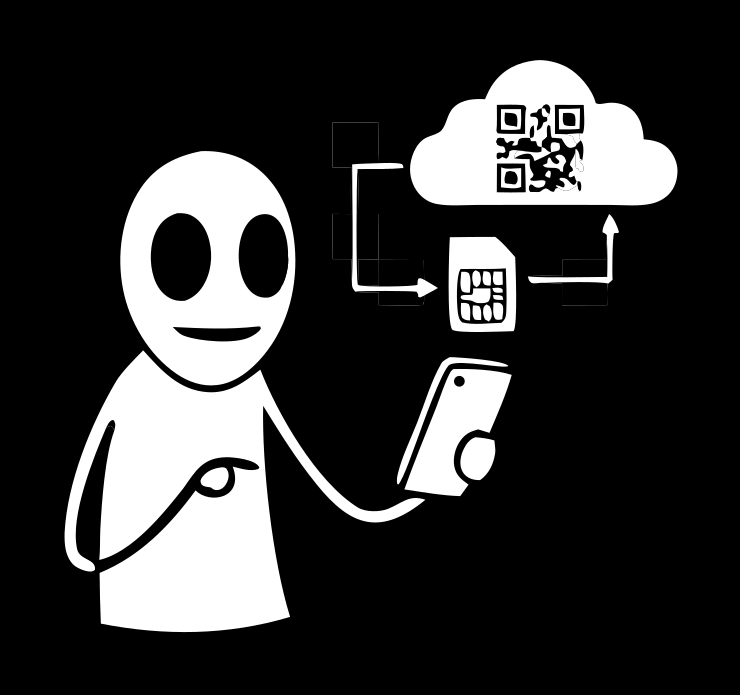
- Ready before you fly. The profile installs at home by QR code; on arrival you just switch on data — no searching for a phone shop.
- Your number stays. Your home SIM keeps working for calls and texts, while data runs through the eSIM. Handy when you're waiting on a bank code to your main number.
- One trip, one plan. Crossing several countries? Take a regional or global plan covering up to 130 countries.
How to choose a plan for your trip
Plans vary by country, data amount and validity — the right one follows your route:
- One country. A country plan is usually the best value per gigabyte.
- Several countries in one region. A regional plan for Europe or Asia saves buying a separate one at each stop.
- A multi-stop or open-ended trip. A global plan works across dozens of countries at once — handy when the route isn't fixed.
- Data amount. Maps and messaging need little; video and working on the road need more, so buy with headroom. When data runs out, you can top up the same profile if a compatible plan exists.
Prices in the catalogue start from 0.43 USDT, so a short-trip plan is easy to find.
How much data to take
To avoid overpaying or running dry, match the plan to what you'll actually do:
| Use | Per day | What it covers |
|---|---|---|
| Maps & messaging | up to 0.5 GB | navigation, chats, email, the odd photo |
| Typical tourist | 1–2 GB | social media, maps, music, calls |
| Heavy video & work | 3 GB+ | video calls, streaming, uploads, hotspot |
Multiply the daily figure by your trip length and add a little buffer.
eSIM, a local SIM, or roaming
Three ways to stay connected abroad, and the eSIM wins on balance:
- Home-carrier roaming. Nothing to set up, but the priciest way to get data on a trip.
- A local SIM. Cheap, but you have to find a shop, buy with ID and change your number — sometimes awkward for a tourist.
- An eSIM. Bought online ahead of time, installed in minutes, your number kept. The middle ground without either downside.
Popular destinations
Plans cover most travel destinations — the United States, the UK and Europe, the UAE, Turkey, Thailand, Japan, Mexico and more. For a route across several countries, a regional plan is easier than a stack of separate ones: a single profile works the whole way, so you're not switching plans at every border. For a single-country trip, a local plan usually gives the best value per gigabyte. Either way, you buy before you leave and arrive already covered.
Getting online with Freeland eSIM
Freeland eSIM is travel data from the app: country, regional and global plans covering up to 130 countries, installed by QR code, with your remaining data and validity on screen. Pay from your balance with whichever method your account supports at checkout. It's one of four tools in Freeland by Mr Freeman.
The full travel kit sits in one account:
- eSIM — data without roaming.
- VPN — private access and a choice of exit country when you need it.
- Card — a virtual card for hotels, tickets and services abroad.
- Number — a virtual number for SMS if a local service asks you to register.
How to set up an eSIM for travel
- Create an account — via Telegram, email or a crypto wallet.
- Choose a plan — by country, region or a global plan.
- Pay the way that suits you.
- Install the profile by QR code ahead of time, at home.
- On arrival, turn on data roaming — data appears within minutes.
Full install walkthrough — in how to install an eSIM.
What to keep in mind on the road
Honest notes so there are no surprises:
- Phone support. eSIM works on most, not all, models — check your device before the trip.
- Activation isn't always instant. In some countries and networks the profile takes a while to connect; leave a little buffer.
- Signal depends on coverage. No plan guarantees a network in every spot — in remote areas there may be no data.
- Data roaming is required. Without it, a foreign profile won't go online.
FAQ
Do I still need my carrier's roaming if I have an eSIM?
No. The eSIM is a separate plan for the destination; leave home roaming off and keep your main SIM just for calls.
Which is better — one global plan or several country plans?
For one or two countries, country plans are cheaper. For a wide or undecided route, a global plan is easier and often better value overall.
Will an eSIM cover maps and rideshare apps abroad?
Yes. Maps, taxis and messengers need only a small daily allowance — half a gigabyte a day is plenty with room to spare.
Can I buy the eSIM before I travel?
Yes, and it's the best approach: install the profile at home and switch it on when you land.
Does my main number keep working?
Yes, if you leave your home SIM active. If you want a separate local number, see Freeland Number.
What happens to my eSIM when I get home?
It simply stops once the plan's data or validity ends — nothing to cancel. You can remove the profile from settings, and reinstall or buy a fresh plan for your next trip.
An eSIM for travel is data ready before you fly and no roaming bill on arrival. Freeland eSIM connects in minutes, paid any way you like.