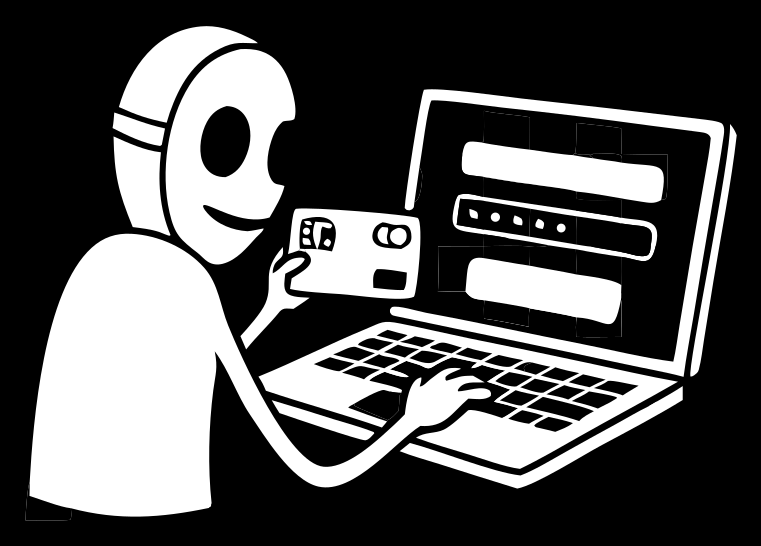
This page describes the standard subscriptions card issued without KYC. The separate Apple Pay / Google Pay wallet card normally requires KYC and is capability-gated; invite-only VIP no-KYC wallet access is not a public offer. Telegram Stars and restricted internal-product balance cannot fund card issue or top-up. Merchant acceptance is not guaranteed and depends on each service's current anti-fraud rules.
"Anonymous card" and "no-KYC card" aren't about being invisible — they're about not handing over an identity to get a card: no passport, no address proof, no selfie. People use one to avoid leaving extra personal data for a one-off online payment. Let's be straight about what a no-KYC card gives you, what it doesn't, and how to get one.
What "no KYC" means
KYC (know your customer) is the standard identity check: passport, address, sometimes a selfie and proof of income. A card issued without KYC skips that — you get working details without uploading documents. That's what people want from "anonymous virtual card" and "virtual card without KYC": less data at the door, a faster issue, and no link to a banking profile.
But "no KYC at issue" and "full anonymity" are different things. Here's where the line sits.
The honest limits of "anonymous"
Promising true invisibility would be a lie. What's actually true:
- The merchant sees the payment. Whoever you pay records that a payment happened, and for how much — same as any card. A no-KYC card hides your link to a banking identity, not the payment itself.
- Crypto isn't fully anonymous. Funding via crypto is pseudonymous: transactions are public on the blockchain, just not signed with your name.
- An account still exists. The service needs a login — via Telegram, email or a crypto wallet. That's not a passport, but it's not anonymity either.
- Responsibility stays with you. No KYC doesn't override a merchant's rules or the laws where you live. The card is a privacy tool, not a way around the law.
A clear-eyed view of this matters more than a bold claim. Freeland deliberately doesn't promise what it can't deliver: the privacy here is real, but it has honest edges.
Why a no-KYC card is still useful
Even with those caveats, the use cases are real:
- Less data on unfamiliar sites. Pay once on a site you don't fully trust without exposing your main card.
- A separate card for subscriptions. Keep recurring charges apart from your main account, capped by the card balance.
- Spending crypto directly. Fund from a wallet and pay online without off-ramping to a bank — see crypto virtual card.
- A fast start. Ready in minutes — no waiting for approval, no document upload.
The Freeland Card without KYC
Freeland Card is a virtual card issued online without KYC — no passport, address or selfie. Use it for subscriptions, online services and one-off payments. It's one of four tools in Freeland by Mr Freeman, alongside VPN, eSIM and Number.
How it works:
- Issued without documents. An account is enough — no verification step.
- Funded any way. Top up the balance with USDT from the unrestricted wallet or another eligible source shown by the app, then fund the card from it.
- Clear fees. Issue 10 USDT, first top-up from 25 USDT (lands on the card balance), 2% on later top-ups and 3% per payment. No monthly fee.
- A KYC card exists too. Separately, Freeland offers a card for Apple Pay and Google Pay that does go through verification. Two different programs: no-KYC for online payments, KYC for contactless via a wallet.
KYC vs no KYC at a glance
| Without KYC | With KYC | |
|---|---|---|
| Needed to issue | Just an account | Passport, address, selfie |
| Speed | Minutes | After verification |
| Freeland use | Online payments, subscriptions | Apple Pay & Google Pay |
| Data about you | Minimal | Full profile with the provider |
Both exist for a reason. Verification is required where a card is added to a phone wallet and tapped in shops — that's the provider's rule. For online payments, where entering the details is enough, the extra paperwork adds nothing, which is why the no-KYC card is faster and lighter on data.
Making privacy stronger in practice
A no-KYC card is one layer. To get more privacy, people combine it with a few habits:
- A separate email or Telegram for signup — not your main personal contact.
- A VPN at checkout — so the service doesn't tie the payment to your real IP and city.
- A limited balance — hold only what the next payments need.
- Different cards for different jobs — subscriptions apart from one-off buys.
This doesn't make you invisible, but it noticeably shrinks your footprint — which is the realistic goal.
Where a no-KYC card won't help
Being honest about the edges matters more than a sales pitch. This card won't:
- Withdraw cash or send transfers — it's an online payment card, not a full bank account.
- Tap in shops — for Apple Pay and Google Pay you need the verified card.
- Get around laws or a merchant's rules — no KYC doesn't change your obligations.
- Make you invisible — if the goal is that no payment is recorded anywhere, no card does that.
If your aim is less data on ordinary online payments, this fits. If you need full banking features, look to a proper account.
FAQ
Is a no-KYC card completely anonymous?
No. "No KYC" means no ID or verification to issue it. The payment is still visible to the merchant, and an account exists for login. It's privacy, not invisibility.
Do I need a passport to issue one?
No. The no-KYC card needs no documents. A passport and selfie are only for the separate Apple Pay / Google Pay card.
How is it funded?
Top up the account balance with USDT from the unrestricted wallet or another eligible source shown by the app, then fund the card from the balance.
Does crypto make the payment anonymous?
No. Crypto is pseudonymous — transactions are public on the blockchain, just not signed with your name.
Is this legal?
Using a no-KYC card for personal purchases is a normal practice. Following each service's rules and your local laws is your responsibility.
What does it cost?
Issue 10 USDT, first top-up from 25 USDT (lands on the balance), 2% on later top-ups and 3% per payment. No monthly fee.
A no-KYC card means less data at the door and a fast issue — not a cloak of invisibility. Freeland Card is issued in minutes without documents, and its privacy is real, with honest limits.